
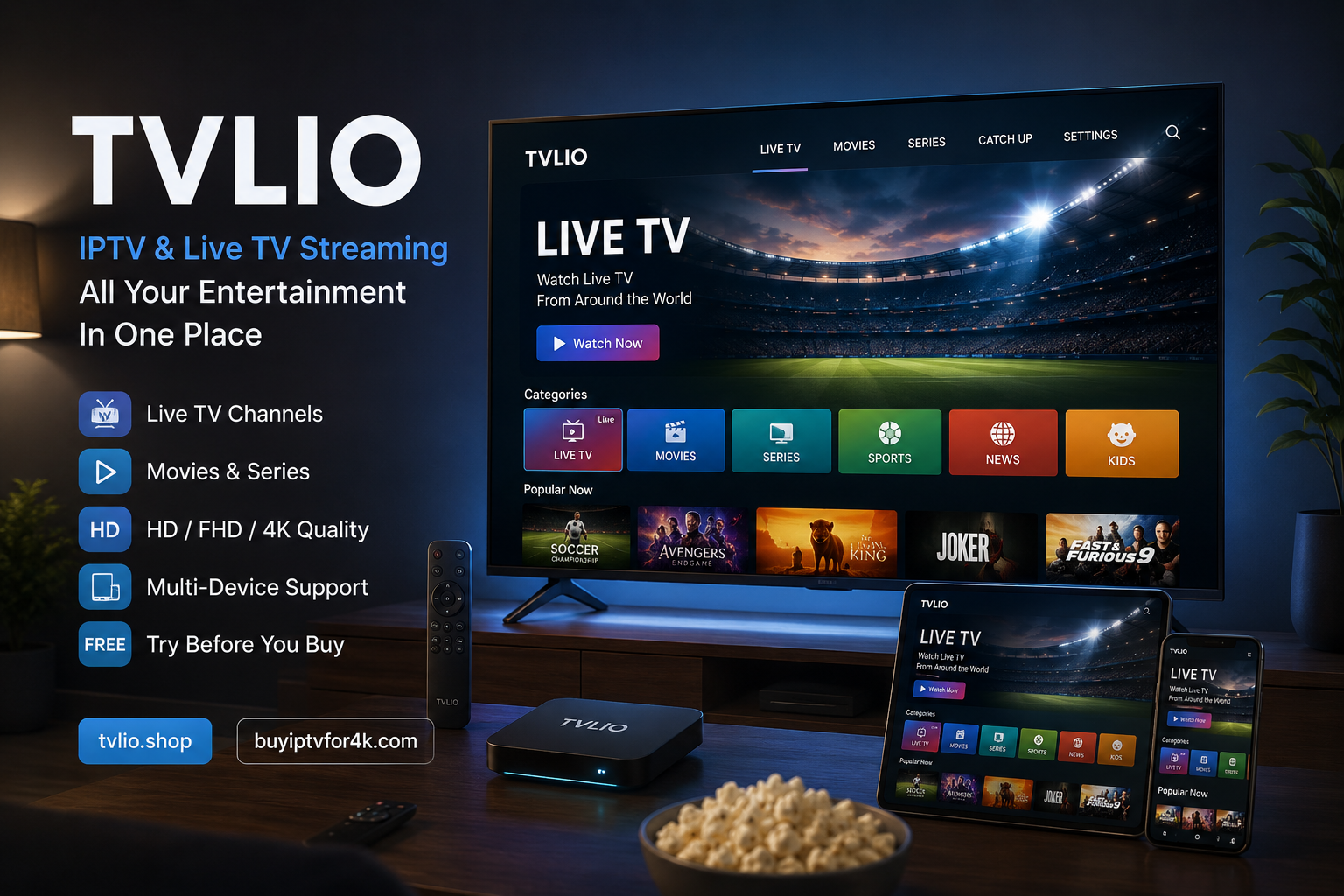
The way people watch television has changed dramatically. Instead of relying only on traditional cable or satellite packages, viewers can now access live television and on-demand entertainment through internet-connected devices. IPTV is one of the technologies behind this shift, giving viewers a flexible way to access television content over an internet connection.
TVLIO is positioned around the modern streaming experience, with a focus on making television accessible across compatible devices and helping viewers understand the options available before choosing a service.
For users researching IPTV services, the most important considerations should go beyond the number of channels advertised. Reliability, device compatibility, streaming quality, customer support, transparent pricing, privacy, and—most importantly—the provider’s rights to distribute the content should all be considered.
This guide explains how IPTV works, what to look for when comparing services, how to evaluate a streaming provider, and how to approach a trial before committing to a longer plan.
What Is IPTV?
IPTV stands for Internet Protocol Television. Unlike traditional terrestrial, satellite, or cable television, IPTV delivers television content through an internet connection.
The basic concept is relatively simple. Instead of receiving a television signal through a satellite dish, antenna, or cable line, compatible content is delivered as data over an IP network.
This technology can support different types of viewing, including:
- Live television
- On-demand video
- Catch-up television
- Replay features
- Movies and television programs
- Interactive television features
The exact features available depend on the provider, application, device, and licensing arrangements.
For viewers, one of the biggest advantages of internet-based television is flexibility. A compatible service can potentially be accessed from a Smart TV, streaming device, smartphone, tablet, computer, or other supported hardware.
Why Is IPTV Becoming Popular?
Traditional television packages can sometimes require dedicated hardware, long contracts, or expensive bundles. Internet-based television provides an alternative approach.
Viewers increasingly want services that are:
- Easy to access
- Compatible with modern devices
- Flexible
- Transparent about pricing
- Simple to cancel or change
- Available across multiple screens
- Capable of delivering high-quality video
The growth of Smart TVs and streaming devices has also made internet television more accessible.
However, popularity should not be confused with reliability. There are many different IPTV services available online, and their quality and legitimacy can vary significantly.
That is why researching a provider before subscribing is important.
TVLIO and the Modern Streaming Experience
TVLIO represents the type of modern IPTV-focused service that users may investigate when looking for alternatives to traditional television.
Before subscribing to any provider, consumers should examine the information available on the provider’s website, including supported devices, pricing, subscription terms, refund policies, privacy information, and the content rights associated with the service.
For information about TVLIO and the services offered, users can visit:
tvlio.shop
A professional streaming service should provide clear information rather than relying exclusively on large channel numbers or aggressive promotional claims.
The objective should be to give customers enough information to determine whether the service fits their needs.
What Should You Look for in an IPTV Service?
Choosing an IPTV provider requires more than searching for the cheapest subscription.
Here are several important factors to consider.
1. Content Availability
The first consideration is whether the service provides the programming you actually want to watch.
Depending on your location and interests, this could include:
- Local television
- News
- Sports
- Entertainment
- Movies
- Children’s programming
- International programming
However, users should always verify that a provider has the appropriate rights to distribute the content in their region.
A large channel list is not necessarily a sign of a high-quality service.
2. Device Compatibility
Device support is another major consideration.
Depending on the provider, IPTV services may support devices such as:
- Smart TVs
- Android TV
- Google TV
- Fire TV devices
- Apple devices
- Android smartphones
- Tablets
- Windows computers
- Mac computers
- Compatible streaming applications
Before subscribing, check the provider’s official compatibility information.
There is little value in purchasing a subscription if your preferred television or streaming device is not supported.
3. Streaming Quality
Video quality is another important factor.
Modern viewers commonly expect HD or 4K content where the source and subscription support it.
However, the final viewing experience depends on several elements:
- Original video quality
- Internet connection
- Device capabilities
- Network congestion
- Streaming infrastructure
- Application performance
A provider should not be judged solely by a “4K” label.
A stable HD stream can provide a better experience than an unreliable higher-resolution stream.
4. Reliability
Reliability may be one of the most important characteristics of any live television service.
Users want streams that start quickly and remain stable.
Potential indicators of a reliable provider include:
- Clear service information
- Responsive customer support
- Transparent policies
- Stable applications
- Properly documented device compatibility
- Legitimate content distribution
Consumers should be cautious about providers that make unrealistic guarantees.
5. Customer Support
Technical problems can happen with any online service.
A good provider should make it reasonably easy for customers to request assistance.
Before subscribing, look for information about:
- Contact methods
- Support hours
- Setup instructions
- Frequently asked questions
- Troubleshooting documentation
- Refund and cancellation procedures
Customer support becomes especially important when a service is being used on a television or streaming device that requires configuration.
Try Before You Buy
One of the most useful concepts when evaluating a streaming service is the opportunity to try before you buy.
A genuine trial can help users determine whether a service works with their:
- Internet connection
- Television
- Streaming device
- Preferred application
- Viewing habits
A trial is more useful than relying solely on screenshots or promotional claims.
During a trial period, users can evaluate the actual experience.
For example, they can check whether channels load correctly, whether the interface is easy to navigate, and whether the service works consistently on their preferred device.
If TVLIO offers a trial, users should review the exact trial conditions, duration, cancellation terms, and applicable restrictions before starting.
IPTV for 4K TVs
The popularity of 4K televisions has increased interest in high-resolution streaming.
A 4K television can display significantly more detail than a standard Full HD screen, but having a 4K television does not automatically mean that every stream will be delivered in 4K.
For genuine 4K playback, several components must support the resolution:
- The content source must provide 4K.
- The streaming service must have the appropriate rights and infrastructure.
- The application must support the required video format.
- The television or streaming device must support 4K.
- The internet connection must be sufficiently capable.
This is why consumers should distinguish between a 4K-capable device and a genuine 4K stream.
Users researching IPTV services for 4K televisions can also review the information available at:
The most important step is to verify exactly what is included in a particular plan rather than assuming every piece of content will be available in 4K.
Internet Speed and IPTV
Your internet connection has an important impact on streaming performance.
Even when a provider has good infrastructure, a weak or unstable connection can cause buffering or reduced quality.
Several factors influence streaming:
- Download speed
- Wi-Fi quality
- Router performance
- Network congestion
- Distance from the router
- Number of devices using the connection
For the best results, a wired Ethernet connection can sometimes provide greater consistency than a congested Wi-Fi connection.
However, modern Wi-Fi networks can also provide excellent streaming performance when configured correctly.
IPTV vs Traditional Television
IPTV and traditional television differ primarily in how content reaches the viewer.
Traditional television can rely on:
- Satellite
- Cable
- Terrestrial broadcasting
IPTV uses internet networks to deliver content.
This creates several potential advantages for consumers.
Flexibility
Internet-based services can often work across multiple compatible devices.
Convenience
Users may not need traditional television infrastructure beyond their internet connection and compatible hardware.
Multi-device access
Some providers support viewing across different types of devices.
On-demand features
Internet television can integrate live programming with on-demand content.
However, IPTV also depends heavily on internet connectivity and service infrastructure.
Is IPTV Legal?
This is one of the most important questions consumers should ask.
IPTV as a technology is legal.
The legal issue concerns the content being distributed and whether the provider has the necessary rights or licenses.
There are legitimate IPTV and internet television services operated by established broadcasters and streaming companies.
There are also unauthorized services that redistribute copyrighted programming without permission.
Consumers should therefore investigate the provider rather than assuming that every IPTV service is legitimate.
Look for:
- Company information
- Terms and conditions
- Privacy policy
- Clear pricing
- Contact information
- Licensing or content-rights information where applicable
- Transparent refund policies
If a service makes extraordinary claims but provides little information about its business or content rights, that should be considered a warning sign.
How to Compare IPTV Providers
A simple comparison checklist can help.
| Factor | What to Check |
|---|---|
| Content | Does it include the programming you need? |
| Legality | Does the provider have appropriate distribution rights? |
| Devices | Is your television or device supported? |
| Quality | Are HD/4K options clearly explained? |
| Reliability | Does the service provide stable playback? |
| Support | Can you reach customer support? |
| Pricing | Are costs clearly displayed? |
| Trial | Is a genuine trial available? |
| Refunds | Are cancellation and refund policies clear? |
| Privacy | Is customer data handled transparently? |
This approach is much more useful than choosing a service solely because it advertises the largest number of channels.
Choosing IPTV for Sports
Sports viewers have particularly high expectations.
Live sports require consistent delivery because buffering or interruptions can be frustrating during important moments.
When evaluating a service for sports, consider:
- Availability of the sports programming you legally want to access
- Supported devices
- Stream stability
- Video quality
- Delay compared with traditional broadcasts
- Customer support
- Subscription conditions
Users should also verify regional broadcasting rights because sports content is often subject to geographic licensing restrictions.
Choosing IPTV for Entertainment
Entertainment viewers may prioritize different features.
For movies and television series, important considerations can include:
- On-demand availability
- Search functionality
- Subtitles
- Audio options
- Picture quality
- User interface
- Parental controls
- Device compatibility
A clean interface can make a major difference when navigating a large content library.
Smart TVs and IPTV
Smart TVs have become one of the most convenient ways to consume internet-based television.
Modern Smart TVs can run applications directly without requiring a separate computer.
However, compatibility differs between television operating systems.
Before subscribing, check whether the service supports your specific platform.
For example, a provider may support one Smart TV operating system but not another.
Always check current compatibility information rather than assuming that all Smart TVs work in the same way.
Fire TV and Streaming Devices
Streaming devices can turn a television into a connected entertainment system.
Depending on the device and provider, users may be able to install a compatible application and access their service through the television.
Before purchasing or subscribing, verify:
- Application availability
- Device compatibility
- Required operating system
- Account requirements
- Supported video formats
Avoid installing unknown applications from untrusted sources.
Security should be treated as an important part of the streaming experience.
IPTV on Smartphones
Smartphones provide another convenient way to access internet-based television.
A compatible service may allow viewing on a phone or tablet, depending on its terms.
Mobile viewing can be useful when:
- Travelling
- Watching news
- Following live events
- Using a secondary screen
- Viewing content away from the television
However, mobile data usage can be significant when streaming high-resolution video.
Users should monitor their mobile data plan if they frequently stream over cellular networks.
Privacy and Security
Consumers should also consider privacy when choosing an online streaming service.
Before creating an account, review the provider’s privacy policy.
Pay attention to:
- Information collected
- Payment information
- Account data
- Cookies
- Third-party services
- Data retention
- Account deletion procedures
Use strong, unique passwords and avoid sharing account credentials unnecessarily.
Consumers should also be cautious about websites that request excessive personal information without explaining why it is required.
Transparent Pricing Matters
A good streaming service should make pricing easy to understand.
Users should be able to determine:
- Subscription price
- Billing frequency
- Trial duration
- Renewal terms
- Cancellation policy
- Refund conditions
If a promotion is advertised, the conditions should be clear.
“Free trial” should not be interpreted as “free forever.” Users should check whether payment information is required and whether the subscription automatically renews.
Why a Trial Can Be Valuable
A trial gives users an opportunity to evaluate the service before making a longer commitment.
During a trial, consider testing:
Performance
Do channels or programs load quickly?
Stability
Does playback remain consistent?
Interface
Is navigation straightforward?
Compatibility
Does everything work correctly on your preferred device?
Support
Can you obtain help if something goes wrong?
Content
Does the service actually provide the programming you are looking for?
These checks can prevent disappointment later.
Common IPTV Mistakes
New users sometimes make avoidable mistakes when choosing an IPTV service.
Choosing Based Only on Price
The cheapest option is not necessarily the best value.
A low price means little if the service does not work reliably.
Choosing Based on Channel Count
A massive channel number can look attractive, but the number alone does not guarantee quality, legality, or relevance.
Ignoring Compatibility
Always confirm that your preferred device is supported.
Ignoring Terms
Read the subscription and refund conditions before paying.
Assuming 4K Means Everything Is 4K
4K availability depends on the actual source and service.
Using Untrusted Applications
Only install applications from trustworthy sources whenever possible.
TVLIO: What Should Customers Check?
Anyone considering TVLIO should review the information presented on the official website and determine whether the service meets their requirements.
Visit:https://tvlio.shop
Potential customers should verify current information about:
- Available plans
- Trial options
- Supported devices
- Content availability
- Pricing
- Customer support
- Refund policies
- Terms of service
- Privacy information
Because online services can change their packages over time, current information from the provider should always take priority over old articles or third-party claims.
Exploring IPTV Options for 4K Devices
For users specifically researching IPTV options for 4K televisions, buyiptvfor4k.com can be reviewed as another source of information about the service and its current offerings.
Before making a purchase, compare the information with your own requirements.
A good decision should consider the complete package rather than one marketing feature.
Frequently Asked Questions
What does IPTV mean?
IPTV stands for Internet Protocol Television. It refers to delivering television programming through internet protocol networks rather than traditional broadcasting methods.
Is IPTV the same as Netflix?
No. IPTV can refer to internet-delivered television services, including live television, while Netflix primarily focuses on on-demand entertainment. The services and content models are different.
Can IPTV work on a Smart TV?
Many IPTV services support Smart TVs, but compatibility depends on the provider and television platform.
Does IPTV require fast internet?
Streaming quality depends on the video resolution and service. Higher-quality video generally requires more bandwidth and a stable connection.
Can IPTV provide 4K?
Some legitimate services provide 4K programming when the content source, subscription, application, device, and network all support it.
Should I choose a yearly IPTV subscription immediately?
It is generally better to understand the service first. If a legitimate provider offers a trial, testing compatibility and performance before committing to a longer plan can be useful.
Is every IPTV provider legal?
No. IPTV is a technology, not a guarantee that every provider has permission to distribute its content. Consumers should verify the provider’s licensing and distribution rights.
What is the best IPTV service?
There is no universal best service. The right option depends on content availability, location, device compatibility, price, reliability, customer support, and licensing.
Final Thoughts
The modern television market gives consumers more choice than ever.
IPTV and internet-based television can provide flexibility across Smart TVs, streaming devices, computers, smartphones, and tablets. However, choosing a provider requires careful research.
Instead of focusing exclusively on channel counts or low prices, consumers should evaluate the complete experience.
The most important factors include:
- Legal content distribution
- Reliable streaming
- Device compatibility
- Transparent pricing
- Video quality
- Customer support
- Privacy
- Clear subscription terms
- Trial availability
For readers interested in learning more about TVLIO, the provider’s current information can be reviewed at tvlio.shop.
Users specifically researching IPTV options for 4K devices can also review buyiptvfor4k.com and compare the information available there with their own viewing requirements.
Ultimately, the best streaming experience is not simply the one with the longest channel list. It is the service that provides the content you are legally entitled to watch, works reliably on your preferred devices, offers transparent terms, and provides a viewing experience that matches your needs.
2 Replies to “TVLIO: A Complete Guide to Modern IPTV and Live TV Streaming”